
National Science Foundation (NSF) Regional Innovation Engines and similar ecosystem-building organizations depend on long-term, coordinated effort from a broad set of regional actors — researchers and entrepreneurs, but also economic developers, community colleges, community organizations, and policymakers. None of them will commit to that work unless they already believe innovation matters to their own goals, share a theory of how it happens, and accept that the chosen industry is the right bet. In most regions, that kind of consensus doesn't exist. That means shaping those beliefs is an essential part of an ecosystem builder’s work.
Building a credible shared narrative requires NSF Engines and similar organizations to define their key terms precisely, make the case for innovation to partners who don't care about it for its own sake (and vice versa), and describe existing regional industries as both a source of risk and an essential partner in innovation.
The act of innovation, as typically understood, depends on the interaction of a relatively narrow set of actors sharing a roughly similar background and set of assumptions about the world: researchers and tech transfer offices, entrepreneurs, venture capitalists, and corporations need to agree on which technologies have commercial potential given the evolution of an industry. And those shared beliefs can be held across national or global networks. Connections between a researcher in Birmingham, a venture capitalist in Atlanta, and a corporation headquartered in New York can yield new patents, well-funded startups, acquisitions and IPOs – the markers of success for most regional innovation efforts.
But the particular kind of innovation that NSF Engines and similar kinds of innovation ecosystems are working to stimulate requires a shared understanding – of what the economy is and what it could and should be – to be held among a much broader set of actors within a region. This is because innovation ecosystems require long-term, coordinated effort by organizations that generate and commercialize ideas, but also organizations that capture the benefits of that innovation by attracting businesses, building workforce pipelines, developing industry-relevant infrastructure, and passing supportive policies.
All of these actors need to believe that innovation in general matters to their own goals. They need a shared theory of how innovation happens. And they need to believe that the prioritized industry or technology is the best way to generate innovation that matters.
There is no region in which there’s anything close to a consensus among a critical mass of organizations on any of these topics, much less all three. That’s why, even if it’s not a pillar of their strategy or a line-item in their budget, these ecosystem builders are, to a substantial degree, in the business of shaping beliefs that are upstream of the work for which they are technically responsible. Shaping beliefs, or narratives, may seem a task that’s incongruous with the scientific rigor of the NSF or the pragmatic, results-oriented nature of the organizations leading regional coalitions. But economic geographers have affirmed in many studies that narratives are a measurable phenomenon that really does matter to big-picture regional economic outcomes.
Michael Storper, in his 2013 book Keys to the City, describes narratives as being critical for allowing a wide range of actors within the region to align around high-potential opportunities, which are ever-changing. When a diverse set of actors apply the same “interpretive schemes” to economic information they can better make sense of where certain industries are headed, what opportunities exist, which capabilities matter, what counts as success, and how to evaluate potential partners or investments. But shared narratives about what the economy is and who it’s for can also change the degree to which different entities are willing to invest in shared assets: Storper writes: "When regional identity is strong, actors are more willing to engage in the patient, difficult work of building collective capabilities because they see those capabilities as 'ours' not just 'someone else's that might benefit me.'"
Similarly, in her influential book Regional Advantage, AnnaLee Saxenian describes how, in contrast to Boston, in Silicon Valley “engineers came to define themselves, and their loyalties, in relation to the region's technical community rather than to individual firms.” When a credible narrative yields coordinated action, a virtuous cycle can occur wherein that action enhances a region’s innovation capabilities, thereby validating the narrative and allowing even more ambitious narratives to be seen as credible, and so forth. (The opposite can also be true; scholars of rust belt regions have found that narratives about regional decline can be self-fulfilling.)
We wrote in our earlier post on Metrics for Innovation Ecosystems about how metrics can serve as an important early signal of rigor and transparency as well as a useful device for building confidence and enabling shared decision-making over time. But ultimately metrics are only legible and influential if they’re being viewed through a similar lens. No amount of sophisticated and impressive numbers situated in engaging dashboards will convince somebody of the importance or soundness of a strategy unless they already believe the same basic principles about how the economy works, for whom, and how to make it better. As a practical matter, ecosystem builders may need to create metrics well before they’ve made much progress on shifting the regional narrative, but they cannot assume that metrics will accomplish the latter, which requires hard, slow, relational work.
This work is hard because in most regions, there is no consensus on what innovation means, nor a widely-held theory of what counts as economic development, or a shared understanding of what causes economic development, nor a shared fact base about the region’s overall competitive position – for example, where growth is outpacing talent production and vice versa, whether more or fewer middle-wage jobs are being created. So most ecosystem builders cannot build an argument for their particular industry or strategy atop an existing foundation of shared vocabulary and shared theory. Many will need to first build consensus around what innovation is, how it happens, and why it matters.
To achieve this, ecosystem builders need to confront both information gaps and mixed incentives among a wide range of actors. In other words, the problem is not just that the various parties ecosystem builders need to engage have different knowledge about the economy and different experiences that have lent them different “interpretive schemes”. Mapping those information gaps and addressing them in a compelling way is hard enough. But the further complication is that various parties each have an organizational incentive to advance a certain narrative about the region. For example:

To build a powerful narrative in this context, ecosystem builders such as NSF Engines need to:
1. Define key terms.
Regional debates about innovation and economic and workforce development strategy are often hindered by a lack of clarity about key concepts. From a distance it may seem trivial, but when people use core terms in different or inconsistent ways it can lead to areas of consensus being missed and areas of underlying conflict among partners being glossed over. Some use “growth” to refer to population and GDP growth, others use it to refer to expansion of a region’s innovation and industrial capabilities even in the face of population decline. Some see major differences in the goals and methods of “workforce development” versus “talent development” while others use these terms interchangeably. What counts as a “middle-wage” or “family-sustaining” job can vary from $20 to $50 per hour or more depending on who you ask.
Ecosystem builders can’t solve all of these definitional problems for their entire region’s economic and workforce development system, but by being very clear about how they define these terms in their own context, they can quickly ascertain whether disagreements or disinterest from certain partners are the result of real difference of opinion about their strategy, or differences in how certain terms are interpreted. A commitment to clarity, in other words, allows ecosystem builders to more quickly and accurately map where they’re positioned in their region’s landscape of ideas. If they don’t, there’s a real risk that some seemingly steadfast partners will turn out to be undependable, while other potentially valuable partners go unattended to because it seems as though they’re not on board.
Among the kinds of terms that ecosystem builders should take the time to define for themselves and others: innovation, inclusion, competitiveness, resilience, growth, entrepreneurship. This fundamental clarity is a complement, not a substitute, for clearly defining the industry, the occupations involved, the geography of the ecosystem, and so forth.
2. Make innovation relevant to non-innovation actors, and vice versa.
At a high level, potential partners of NSF Engines and their peers will break into two groups: those that believe that innovation is a goal unto itself, and those who only care about innovation insofar as it achieves other goals.
Many in the latter group are skeptical of innovation, meaning that they doubt that investing heavily in use-inspired research and commercialization is likely to yield growth or inclusion outcomes. It is important that ecosystem builders recognize that their skepticism is often well-founded. These organizations have seen many flashy innovation-oriented initiatives – from branding campaigns to cluster strategies to “grand challenges” from universities – come and go, often as regional leaders sought to grab onto “hot” new technologies. (As evidenced by the number of regions with “Silicon ______” branding efforts.) They’ve seen big business attraction “wins” that quietly result in a fraction of the announced jobs created. They’ve seen high-profile local startups depart for bigger tech hubs. They’ve seen huge investments in university research centers that seem to yield little in the way of economic progress. Perhaps most importantly, they’ve seen that even when innovation does manifest in the form of businesses, it mostly creates a handful of high-wage, high-skilled jobs rather than rebuilding the hollowed-out core of the labor market.
Ecosystem builders have to convince this group of skeptics that their technology has a real opportunity to grow into an industry, and one that will create an abundance of attainable, middle-wage jobs and wealth-creating entrepreneurial opportunities that don’t require an advanced degree. In some regions, given their focus industry, it may be hard to make a credible case that this will happen directly in the industry, which raises the need to rigorously examine how the industry’s growth will create supply chain opportunities. (Which are very different from the “induced” jobs that are often included in economic impact estimates – these include many low-wage jobs in service sectors.)
Meanwhile, ecosystem builders also need to convince the innovation enthusiasts – who tend to be drawn to entrepreneurial efforts that move fast, or even “fail fast” – that it’s worth spending time and money on building workforce pipelines, supporting technology adoption in legacy industries, and creating a conducive policy environment. Ecosystem builders need to convince those who are hungry for tangible investments in research funding, lab space, test beds, and so forth that investing in engaging and building the capabilities of entities on the periphery of the innovation ecosystem will ultimately result in more and better innovation and faster-growing firms. For example, several studies have found strong evidence that when manufacturing is collocated with R&D, it strengthens innovation – Mercedes Delgado found that clusters characterized by this kind of colocation were twice as patent-intensive as others. But for manufacturing to occur in close proximity to R&D requires organizations dedicated to growing the manufacturing sector – business attraction entities that know how to prepare sites, state and local entities that control incentives, workforce development organizations that can do industry-oriented training, and so forth – to know about and care enough about the ecosystem’s industry to do the difficult work of learning about its needs and building customized programs and policies. Ecosystem builders need to convince their innovation-oriented partners to stick with them while they build networks that pull these economic and workforce development entities into the innovation ecosystem.
3. Artfully describe existing industries as both a liability and an asset.
The narrative that NSF Engines and other ecosystem-building organizations advance needs to walk a fine line: it needs to create urgency by noting that the region’s dependence on existing industries is a risk, but also that these industries are both a potential source of innovation and a beneficiary of innovation. If the narrative leans too far towards disruptive innovation, engines can lose the allegiance of incumbent industries, the economic and workforce development organizations that have invested for years in understanding and building connections in those industries, and policymakers from the communities where those industries exist. If the narrative leans too far towards incremental innovation in incumbent industries, engines can lose the energy and dynamism that more entrepreneurial partners bring.
Fortunately, it is not hard to tell a story that links old industries and new ideas as equally important contributors to innovation. There is strong evidence that for most regions, innovation does largely happen when strengths of existing industries – production know-how, supplier networks, specialized skills, customer relationships, regulatory fluency – collide with ideas, technologies, and methods arriving from newer or faster-moving domains. Research on economic complexity by Cesar Hidalgo and Ricardo Hassman shows that regions successfully diversify by moving into industries that share capabilities with their current base – what Stuart Kauffman calls the "adjacent possible."
As ecosystem builders like NSF Engines articulate a vision of how their industry will generate new and better growth in their regions, they should be sure to emphasize that existing businesses and their workers are essential contributors to innovation – and that a key goal of the ecosystem builders is to breathe new life into them rather than replacing them. This is both an accurate description of how innovation happens, and essential to building the partnerships that ecosystem builder needs.
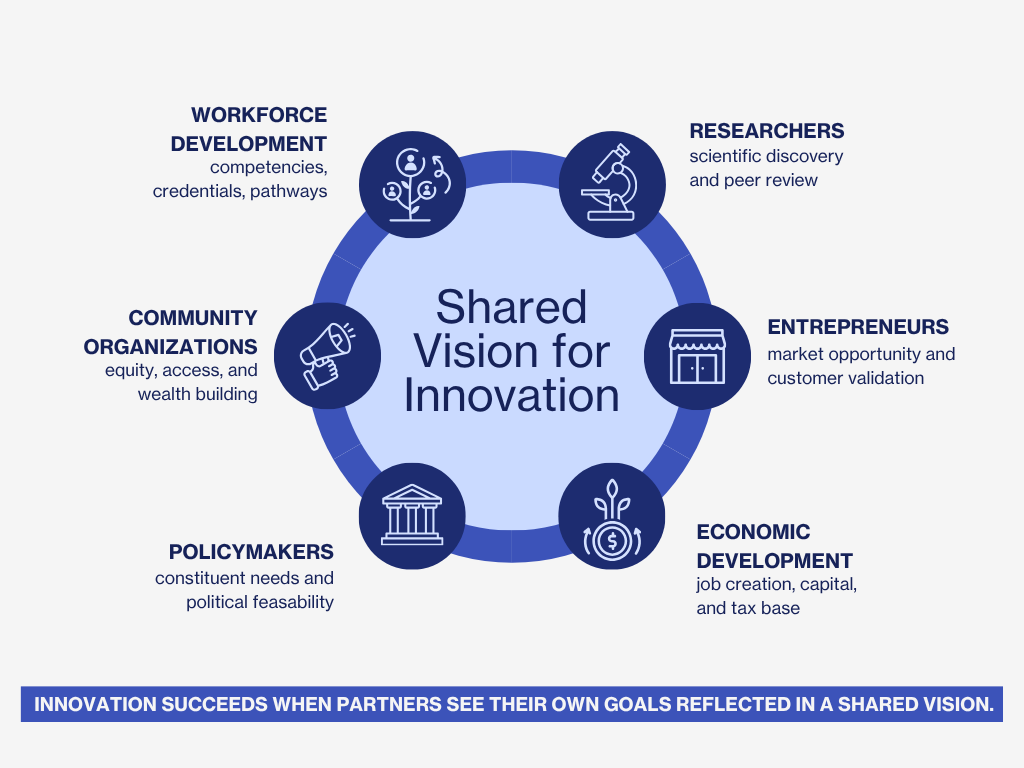
Innovation ecosystems are engaged in deeply translational work—in both senses of the term. They're focused on translational research, moving discoveries from the lab toward real-world application and commercial viability. But to get from commercial viability to visible economic impact, they have to translate across the many different languages spoken within and beyond their regions' innovation ecosystems. Researchers speak the language of scientific discovery and peer review. Entrepreneurs speak the language of market opportunity and customer validation. Workforce development organizations speak the language of competencies, credentials, and career pathways. Economic development practitioners speak the language of job creation, capital investment, and tax base. Community organizations speak the language of equity, access, and wealth-building. Policymakers speak the language of constituent needs and political feasibility. Ecosystem builders must become fluent in all of these languages and build a narrative compelling enough that each of these groups can see their own goals reflected in the ecosystem vision.
This post is the fifth in a series of six blogs describing key elements of ecosystem-building, with an emphasis on system-building, grounded in the experience of engines. The series is authored by Ryan Donahue and Francie Genz, who have spent years studying the essential capabilities that allow regions to change their economic future by getting organized across public, private, and nonprofit sectors. These blogs are designed to highlight some of the most essential and difficult aspects of ecosystem-building, describing key strategies as well as what they look like in practice, drawing from examples within the engines network and beyond.