
Industry engagement is essential to building strong innovation ecosystems, but in practice, it’s one of the weakest links. The right approach to industry engagement depends on what you're trying to get from it. For example, gaining insight into workforce demand requires a very different conversation, with different individuals, at a different depth than getting companies to co-invest in a pilot or change their hiring practices. When ecosystem builders treat these goals as interchangeable, they end up designing strategies that don't actually fit any of them.
The most effective industry engagement approaches start with an honest answer to a simple question: what do we actually need from the private sector right now? Getting specific about that, and calibrating engagement strategy accordingly, is essential to building strategic partnerships that produce real results vs. staying at the surface.
This blog draws on two conversations among National Science Foundation (NSF) Regional Innovation Engine leaders convened as part of The Builder Platform, a community of practice for engine teams. In the fall, we invited two outside practitioners, Erin Bibo from CityWorks DC, and John McDonald from Tulsa Innovation Labs, to share what they have learned about moving from superficial business engagement to sustained private-sector activation. Earlier this year, engine leaders continued that conversation from their own experience. The insights from both discussions form the basis of what follows.
In most regional innovation ecosystems, the list of what the private sector is expected to contribute is long. Companies are asked to provide market intelligence, signaling where technology is heading and what workforce skills they actually need. They are asked to contribute resources: dollars or in-kind support. They are asked to lend legitimacy, signaling to others in the ecosystem that an initiative is worth taking seriously. They are asked to engage in direct problem-solving, sharing data and co-investing in solutions. And ultimately, they are asked to change their behavior, for example hiring more intentionally, adopting new technologies, or changing procurement practices.
All of these contributions matter. The trouble is that pursuing all of them simultaneously, through the same channels and with the same tactics, tends to produce none of them particularly well. It is common for organizations building regional innovation ecosystems to approach companies with a broad pitch, seeking input, dollars, endorsement, and partnership all at once. Companies, especially large, publicly traded firms operating on quarterly timelines, struggle to locate their role in that kind of conversation.
Companies may agree to lend their name to an initiative or show up to a convening, but without a clear and specific role to play, that involvement rarely translates into action.
Erin Bibo, who has spent years working to change the role the private sector plays in regional workforce development, described her own evolution on this point plainly: "When I used to lead career education for our city's school district, I came to industry with a pre-baked solution. I didn't ask them to help shape it, I just asked them to sign on." That approach, she reflected, produced superficial engagement at best. Companies would agree to support an initiative as a gesture of goodwill, but those commitments rarely translated into sustained involvement. What changed when she began designing strategy with business leaders from the outset, starting with their collective priorities and pain points, was both the quality of the strategy and the honesty of the conversation. "We actually wanted many of the same things," she reflected. "We all wanted local residents to get quality jobs at their companies. They wanted that too." What companies hadn't said out loud was that the strategies being presented weren't solving their problems in the way they needed them solved, or on the timeline they needed them solved.
The core challenge is that industry engagement is not one thing. It is several distinct activities, each with its own logic, its own set of right partners, and its own pathway to success. Treating them as interchangeable is one of the most consistent ways these efforts go wrong.
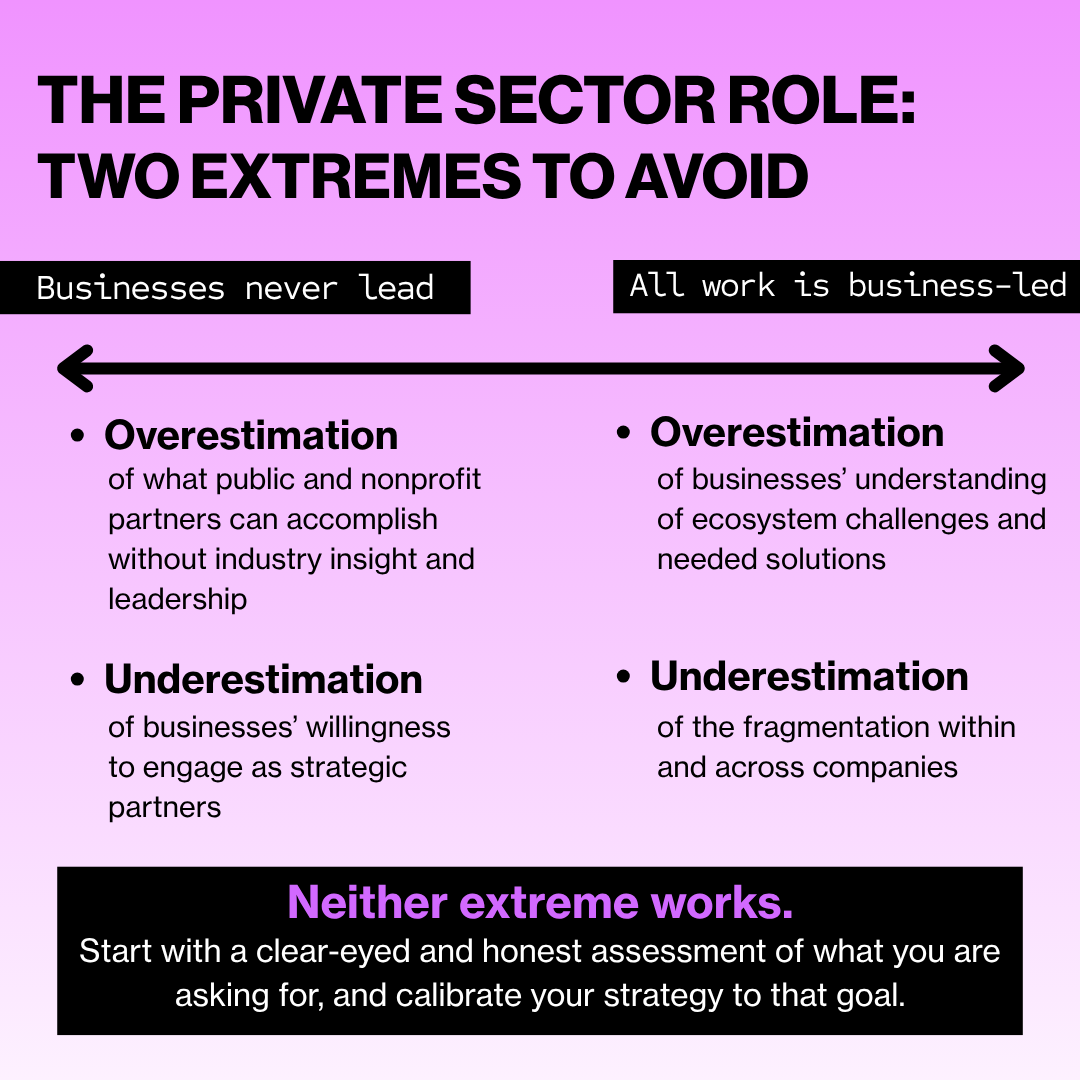
Opinions on how much to ask of companies tend to cluster at two unhelpful extremes. At one end, some believe that strategies should be entirely business-led, expecting the private sector to take full responsibility for shaping and driving the agenda. This is rarely realistic, however, especially when the scope extends beyond what companies see as their direct self-interest. Without a compelling case for how a broader agenda unlocks their own competitiveness or innovation, companies are unlikely to sustain the kind of deep commitment that complex, long-term strategies require. Even the most civic-minded firms rarely have full visibility into the systemic challenges that public and nonprofit partners navigate, which limits their ability to lead effectively, even with the best of intentions.
When this approach falls short, the instinct is often to overcorrect. Rather than asking too much of the private sector, organizations begin asking too little, presenting mostly pre-formed strategies and seeking light-touch endorsement rather than genuine co-creation. As a result, strategies are largely shaped by public and nonprofit institutions without sufficient pressure-testing by the companies that will ultimately need to act on them. Business leaders, having had little hand in shaping the agenda, feel limited ownership over it and are less likely to step up when it is time to implement.
Neither extreme works. What is needed instead is a clear-eyed and honest assessment of what is actually being asked for, and a strategy that is calibrated to that goal.
One of the most useful reframes for the organizations and leaders doing this work is to think about industry engagement not as a single strategy, but as an order of operations. Different contributions from the private sector tend to unlock one another sequentially, and understanding that sequence helps clarify where to start.
Gathering market intelligence from companies–getting honest insights into what technologies companies are actually willing to adopt, what workforce skills they genuinely need, what problems they are trying to solve—is often the natural starting point that leads to deeper, more strategic relationships. It is also the most accessible place to begin, because it requires relatively little of companies upfront.
A candid conversation about technology priorities and pain points is far easier to secure than a multi-year commitment to co-invest.
And yet those early conversations, done well, lay the foundation of trust and mutual understanding that makes deeper engagement possible over time.
Legitimacy and influence tend to follow from the right early relationships. When a respected regional employer signals that an initiative is worth their attention, others take notice. This kind of private-sector credibility is often underestimated and, in many instances, it can be more valuable than a financial contribution.
This sequencing shows up clearly in the work of Tulsa Innovation Labs, which built a nonprofit venture studio, Rose Rock Bridge, by starting with a single energy company that recognized the value of a shared, philanthropy-supported model for scouting and piloting new technologies. That early buy-in acted as a signal. Others looked over their shoulder, saw what was working, and joined the next cohort. "It's less about what you say," reflected John McDonald, "and more about finding one company that gets it, delivering consistently excellent results, and letting that success draw others in." The harder asks, for resources, long-term commitment, genuine behavior change, followed from that foundation, not the other way around.
The most durable industry partnerships do not begin with a grand vision and long-term partnership; they begin with a smaller, well-defined ask that both sides follow through on.
Conversations about industry engagement often get stuck on the distinction between transactional and relational approaches, as if one is a failure mode and the other is the goal. Transactional sounds inadequate: shallow, short-term, driven by narrow self-interest. Relational sounds aspirational: deep, committed, built on shared purpose.
But this framing can actually get in the way. Relationships are built on transactions. Fulfilling a series of clear, well-matched commitments (for example, you tell us what you need, we deliver something useful, you see the value) is how trust builds. Deeper partnerships that ecosystem builders are rightly aiming for don't replace transactions; they grow out of them.
The more common problem is not that industry engagement is too transactional; it is that the terms are left vague, and both sides enter the relationship with different expectations. For example, an NSF Engine may frame the engagement as the beginning of a long-term strategic partnership; the company understands it as a discrete project with a clear end date. When those assumptions are never made explicit, the relationship tends to disappoint both sides. The most effective organizations are simply clear upfront about what they are seeking and what they are offering and they ask their partners to do the same.
Across NSF Engines and regional ecosystems, a few key lessons emerge about what genuine private-sector activation requires.
1. Know what you actually need before making the ask.
Until you are clear about what you need from industry engagement at a specific moment, it is nearly impossible to design a strategy that works. Goals are not interchangeable; seeking market intelligence requires a different conversation, with different people, than seeking co-investment or behavior change. Conflating them leads to asks that feel unfocused to companies and produce little in return.
2. Match the engagement approach to the goal.
Individual firm outreach works well when the ask is specific and the relationship is direct. But when the goal is collective industry influence—legitimacy, policy impact, a shared agenda—individual conversations won't get you there. Engaging through associations, chambers, or other intermediary organizations can be effective for building legitimacy and gathering market intelligence, but deep, problem-solving partnership with the private sector requires a direct relationship with the firms themselves.
3. Don't confuse participation for partnership.
If business leaders are nodding along but not leaning in, you probably haven't tapped their genuine self-interest or given them a substantive enough role to play. Authentic partnership requires that both sides have something real at stake and something real to gain. If you're only hearing "that sounds fine," it's time to ask harder questions or redesign the engagement to give companies something actually worth showing up for.
Business leaders don't need to be convinced that regional innovation matters. But to be genuinely activated as partners in an innovation ecosystem, they need the right role, the right ask, and a clear reason to stay at the table.
That clarity starts with ecosystem builders themselves. The regions and engines that are making progress on industry engagement share a common trait: they are honest, internally and externally, about what they are actually asking for, and they are disciplined enough to match their strategy to that goal.
As we described in the first piece in this series, ecosystem building is not a natural byproduct of bringing the right actors into the same room. The same is true of industry engagement. The regions making real progress are not the ones with the most companies at the table; they are the ones that have been clear about what they need, deliberate about how they ask for it, and willing to invest in the relationships that make sustained private-sector commitment possible.
Reflection Questions
This post is the second in a series of six blogs describing key elements of ecosystem-building, with an emphasis on system-building, grounded in the experience of engines. The series is authored by Ryan Donahue and Francie Genz, who have spent years studying the essential capabilities that allow regions to change their economic future by getting organized across public, private, and nonprofit sectors.
These blogs are designed to highlight some of the most essential and difficult aspects of ecosystem-building, describing key strategies as well as what they look like in practice, drawing from examples within the engines network and beyond.